
From Session to Signed Note: The Complete AI Therapy Note Workflow
The full AI therapy note workflow in PsyFi Practice, worked on one session: record, transcribe, reason in chat, draft the documents, review, and sign.
Read moreSet your default note format, pick one per session, and switch formats after a note is drafted — plus what GIRP and Narrative add to SOAP, DAP, and BIRP.

PsyFi Notes supports five note formats: SOAP, DAP, BIRP, GIRP, and Narrative. Set your default on the Preferences tab of the Settings modal (gear icon, top right); every new recording pre-fills its Note format field from it, and if you never set one the system uses SOAP.
You can override the format per session in the Session details card, and switch it after the fact by regenerating the note from the transcript page. Regenerating overwrites the stored note, so settle the format before you start editing.
There are only three, and knowing which one you are in saves most of the confusion:
In the recorder, the Session details card on the right has three fields: Title, Modality, and Note format. The Note format dropdown offers all five formats; being a standard dropdown, it shows the currently selected one until you open it.
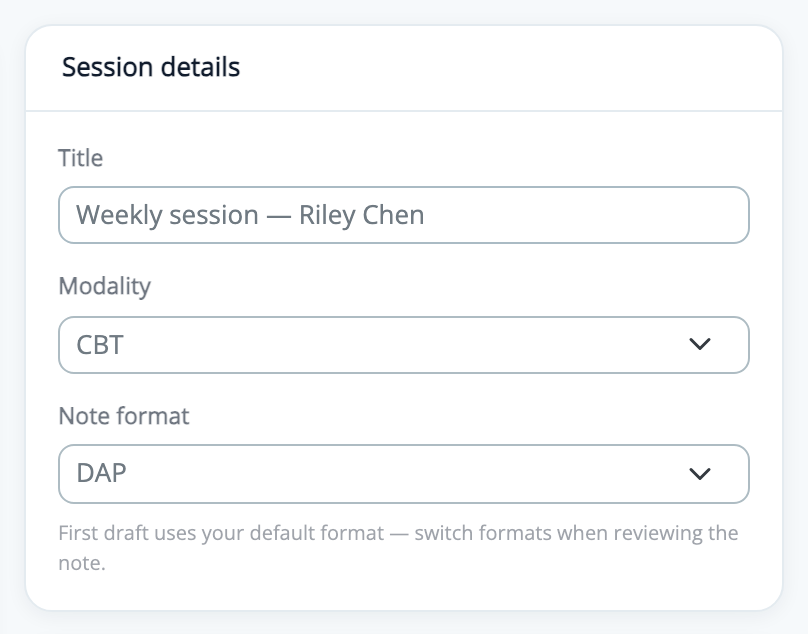
Screenshots use fictional demo sessions.
The helper text under the field says: "First draft uses your default format — switch formats when reviewing the note." That is the whole policy in one line. The pre-session choice determines the first draft only.
Full context on the rest of the recording flow is in how to record a therapy session in PsyFi Notes.
Open the Settings modal from the gear icon in the top right, go to the Preferences tab, and set the Note format dropdown. (The same tab holds Role and Primary use, if you have not filled those in either.)
Every new recording pre-fills its Note format field from that default. If you never set one, the system uses SOAP.
Worth setting deliberately even if you are happy with SOAP, because the field you never look at is the field that quietly produces a hundred notes in a format you did not choose.
On the transcript page, the generated note sits in the right-hand panel with edit, copy, and regenerate controls. Regenerating lets you pick a different format, drafted from the same transcript. No re-recording, no re-typing.
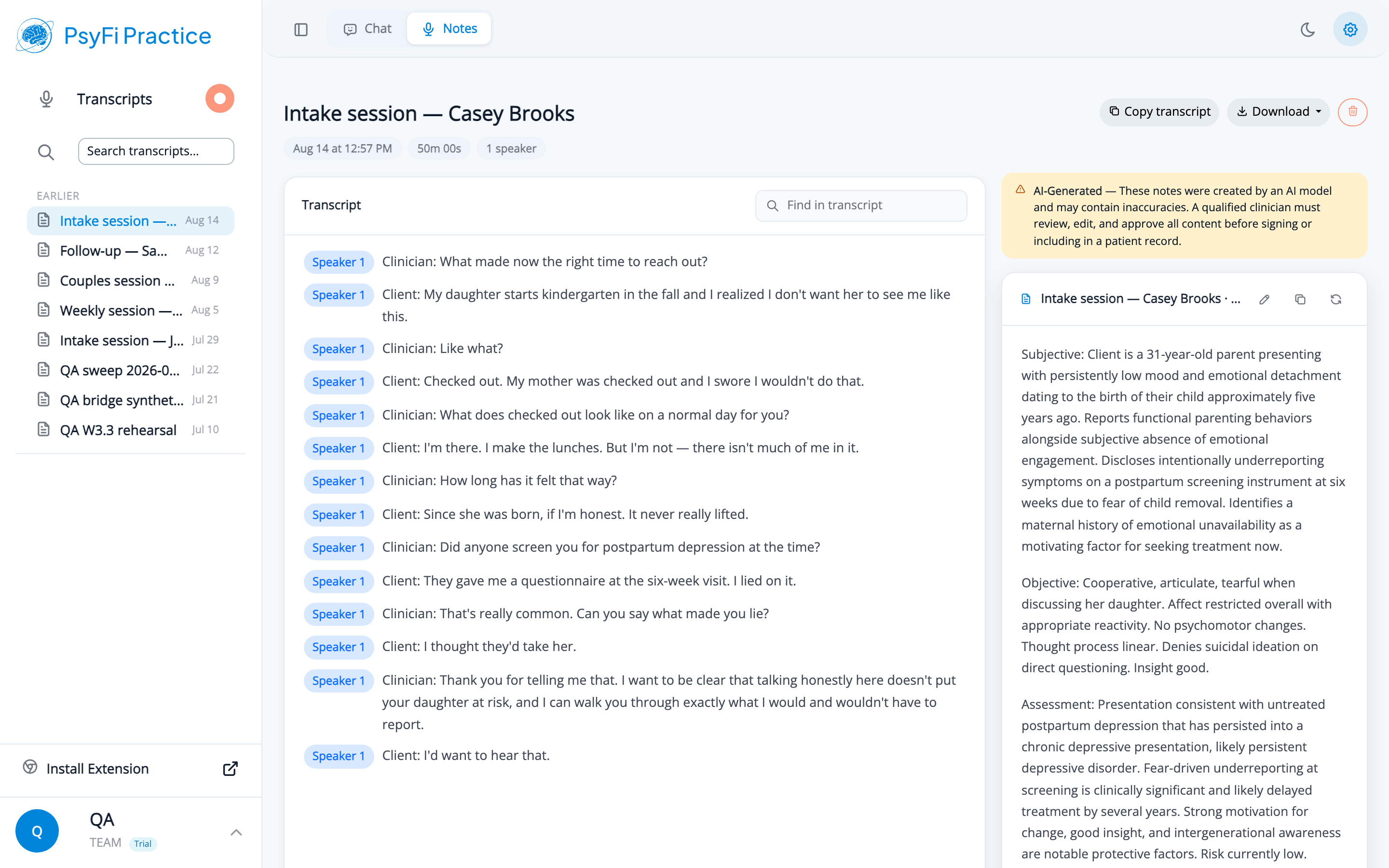
This is genuinely useful in two situations: you realize mid-review that the session does not fit the format you chose, and you need to produce a note in a particular format for a specific payer after the fact.
One thing to get right about the order of operations: regenerating overwrites the stored note. The new draft replaces the old one wholesale. Edits you had already made are not preserved and not merged — they are gone.
So settle the format first, then edit. If you are unsure whether SOAP or GIRP suits a session, regenerate into both and read them before you invest a single correction in either. Editing and then regenerating is the one way to lose work in this workflow.
Configuration is the easy half. If you have not settled on which format you actually want, the order to think about it in:
| Format | Sections | Best fit |
|---|---|---|
| SOAP | Subjective, Objective, Assessment, Plan | Medical-model billing, integrated care, charts shared with physicians |
| DAP | Data, Assessment, Plan | High caseload, solo practice, speed |
| BIRP | Behavior, Intervention, Response, Plan | Demonstrating medical necessity; manualized modalities |
| GIRP | Goal, Intervention, Response, Plan | Goal-driven treatment where plan alignment must be visible |
| Narrative | Continuous prose | Complex or relational sessions that resist sectioning |
SOAP, DAP, and BIRP are covered in clinical depth — with templates and the audit criteria that apply to each — in our comparison of SOAP vs. DAP vs. BIRP notes. Rather than repeat that, the two sections below cover the two formats that post does not.
GIRP — Goal, Intervention, Response, Plan — is structurally BIRP with the first section reframed. Instead of opening with what the client presented (Behavior), the note opens with the treatment-plan goal the session was working toward.
What it buys you. Every note carries the treatment plan on its face. When a reviewer asks whether services were medically necessary and tied to an active plan, a GIRP note answers before they finish the question. It also disciplines the clinician: if you cannot name the goal the session served, that is worth noticing before the reviewer notices it.
Best for: goal-directed treatment where the plan is genuinely operative — case management, intensive outpatient programs, grant-funded or measurement-based care, and any setting where the payer's audit posture is "show me the plan."
Tradeoff: it fails loudly when the plan is stale. A session that spent fifty minutes on something the plan does not mention produces an awkward GIRP note. That is arguably a feature — a stale plan is a real problem, not a documentation inconvenience — but it means GIRP works best alongside a habit of keeping treatment plans current.
Against BIRP: use BIRP when the presenting behavior is the important variable and the plan is a background frame. Use GIRP when the plan is the spine of the treatment and every session should visibly ladder up to it.
A Narrative note is continuous clinical prose. No headings, no four-part scaffold — an account of the session written the way a clinician would describe it to a trusted colleague.
Best for:
Tradeoffs, honestly. Two of them, and both matter.
First, structure is a quality floor. A four-section format forces you to say something about assessment and something about plan; prose lets you write six warm paragraphs that never quite state a clinical judgment or a next step. If you write Narrative notes, check explicitly that your clinical reasoning and your plan are in there. They are the things reviewers look for and the things prose most easily omits.
Second, this is the format where AI drafts need the most editing. A model summarizing a session into fixed sections has a target to hit. A model writing prose will produce something fluent that reads like a recap of the conversation, and a recap is not a clinical note. Expect to rewrite more here than in any other format.
Used well — and reviewed properly — Narrative is the most clinically expressive of the five. It is not the one to pick because you are in a hurry.
Above every generated note is an amber banner stating that the content was created by an AI model, may contain inaccuracies, and must be reviewed, edited, and approved by a qualified clinician before it is signed or included in a patient record.
That requirement is format-independent. A sloppy SOAP note and a sloppy Narrative note are equally indefensible; a well-reviewed draft in either holds up the same way a well-written note always has. The specific things to verify, whichever format you chose:
Standardize by contract, not by taste. Check every payer contract for a specified format, apply those, and let clinicians choose for everything else. Mixed formats across a practice are fine and common; what auditors care about is consistency per clinician and per client, and completeness within whichever format was used.
Where it is worth being firm: everyone should have a deliberate default set rather than inheriting one, and everyone should know that regenerate exists. Those two facts prevent most of the format-related documentation cleanup a practice ends up doing later.
Once the format is settled, the rest of the workflow is the same regardless of which you picked — the session-to-signed-note walkthrough follows a single session from the record button to a note ready for signature.
PsyFi Notes is HIPAA-aligned clinical documentation software backed by a Business Associate Agreement. For questions about standardizing note formats in your practice, contact our onboarding team at [email protected].